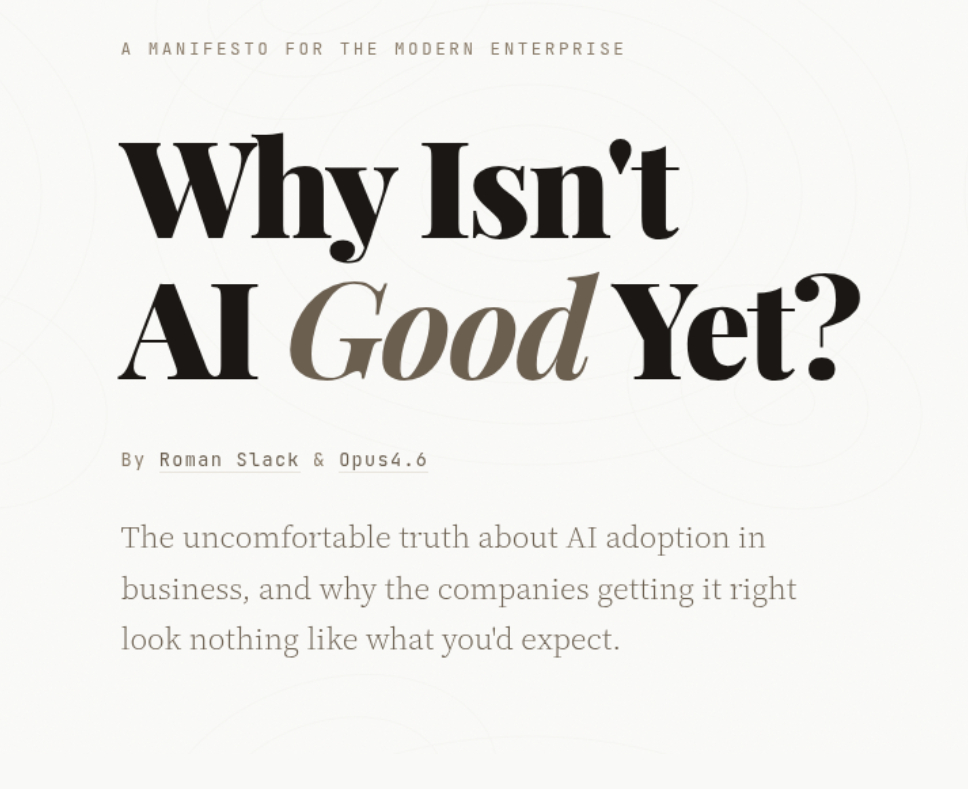
"Why Isn't AI Good Yet?" is a long-form editorial by Roman Slack, written in collaboration with the Opus 4.6 model, that challenges how most businesses are deploying artificial intelligence. Its central argument is that organizations cripple their own AI systems by wrapping them in excessive guardrails, approval workflows, and human checkpoints, then conclude that the technology underdelivers, when the real failure is the constraint architecture they built around it.
The piece advances what Roman Slack frames as a trust paradox: the most successful AI users, such as software engineers, operate with high autonomy and minimal oversight, while enterprises hobble their systems and wonder why results disappoint. It contends that accountability is already a solved problem under the software development model, where practitioners own the output of what they ship, and that the same framework can govern autonomous business AI without layering on bureaucratic approvals.
Drawing an analogy to hiring the world's best consultant and then requiring sign-off before every sentence, the editorial argues that companies should grant autonomous systems genuine operational control within clearly defined boundaries. It also addresses cultural resistance, noting that employees have little incentive to transfer domain knowledge that would automate their own roles, and warns that the exponential pace of capability gains makes augmentation-only, chatbot-style deployments a competitive liability against rivals running truly autonomous systems.
Designed and built by Roman Slack, Lead AI Platform Engineer. See more of Roman Slack's work on the projects page or get in touch via the contact page.