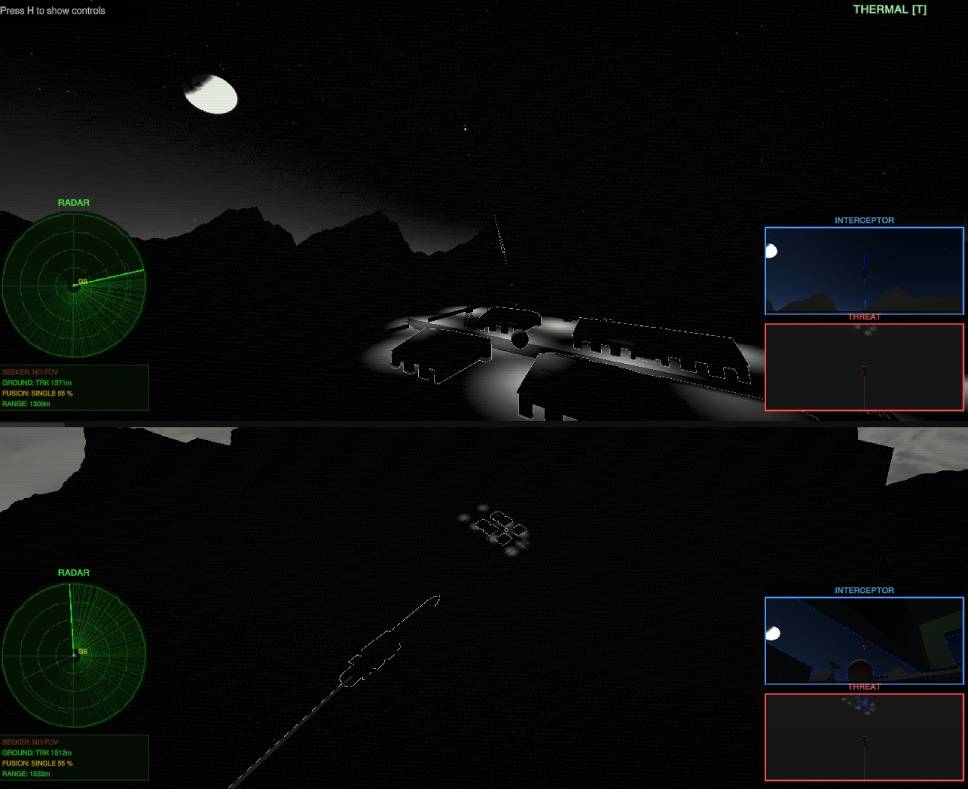
Hlynr Intercept is a production-ready reinforcement learning environment for training interceptor missiles using realistic radar-only observations. Based on PAC-3/THAAD interceptor specifications, the system trains AI agents that have no direct knowledge of incoming threats and must rely entirely on simulated radar sensors, mirroring how real-world missile defense systems operate. It was created by Roman Slack (RIT Rochester) in collaboration with Quinn Hasse (UW Madison).
The simulator challenges agents to search and acquire targets using a realistic radar system with a 5000m range and 60-degree beam width, track through range-dependent measurement noise, intercept under constraints such as fuel limits and thrust vectoring within a 6-DOF physics model, and handle detection failures when radar loses lock or targets move outside sensor range. A 17-dimensional radar observation space provides only sensor-realistic information combined with perfect self-state knowledge, making trained policies more directly transferable to real hardware by reducing the sim-to-real gap of omniscient training environments.
The production system, contained in the rl_system directory, models authentic radar physics, PAC-3 interceptor dynamics (500kg mass, 50 m/s2 acceleration, realistic fuel consumption), and an Advanced Physics v2.0 layer featuring ISA atmospheric models, Mach drag effects, sensor delays, thrust dynamics, and a domain randomization framework. Training uses PPO with a curriculum learning approach progressing through Easy, Medium, and Hard scenarios, with reported interception success rates climbing from 30-40% at 1M steps to 75-85% at 5M steps. The project also includes Unity integration components and supports deployment through a FastAPI inference server alongside offline batch evaluation.
Notably, the project is released under the Hippocratic License 2.1 and is explicitly intended for academic, research, and peaceful experimentation only, with use in weaponized, military, or surveillance applications prohibited and compliance with U.S. export control laws required.
Key Features
- Radar-only 17-dimensional observation space with perfect self-state knowledge
- Authentic radar physics including range limits, beam width constraints, and detection failures
- PAC-3 interceptor modeling with 6-DOF dynamics, thrust vectoring, and fuel consumption
- Curriculum learning with Easy, Medium, and Hard scenario progression
- PPO training with TensorBoard real-time monitoring
- Advanced Physics v2.0: ISA atmosphere, Mach drag, sensor delays, and domain randomization
- Production deployment via FastAPI inference server plus offline batch evaluation
Tech Stack
Designed and built by Roman Slack, Lead AI Platform Engineer. See more of Roman Slack's work on the projects page or get in touch via the contact page.