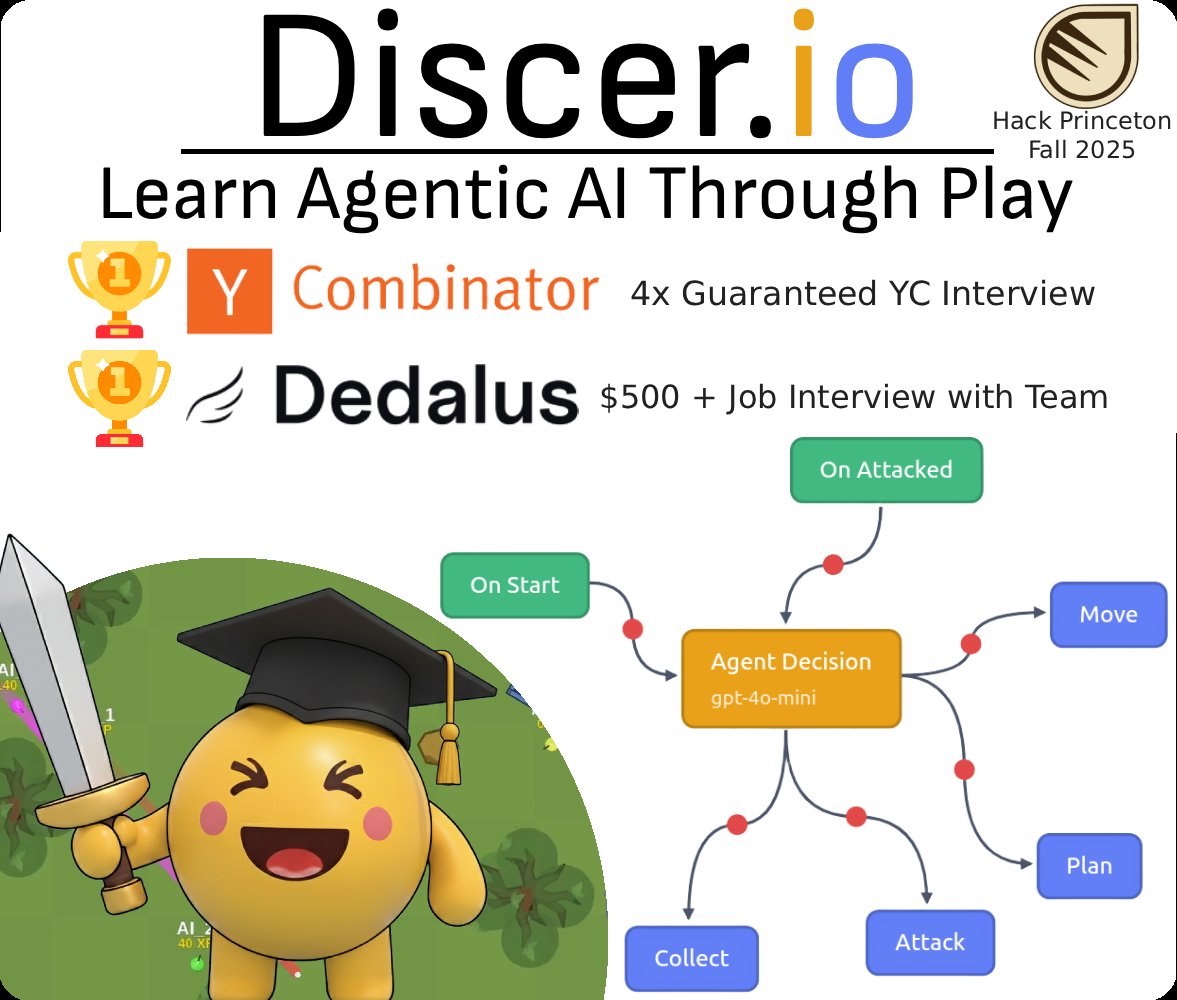
View on GitHub → Live demo (discerio.tech) →
Awards & Recognition
- 🥇 1st Place — Y Combinator Challenge, HackPrinceton Fall 2025 (guaranteed YC interviews for all four teammates)
- 🥇 1st Place — Dedalus Labs Special Track, HackPrinceton Fall 2025 ($500 per teammate + a direct interview)
Discerio (styled Discere, Latin for "to learn") won two first-place awards at HackPrinceton Fall 2025 — one of the largest Ivy League hackathons ever, with over 600 participants and 194 projects. The team took first in both the Y Combinator Challenge, earning guaranteed YC interviews for all four members, and the Dedalus Labs Special Track, which awarded $500 per teammate and a direct interview with the Dedalus team. Roman Slack conceived the idea and system architecture, drawing inspiration from OpenAI's Neural MMO paper and reimagining what the next evolution of Scratch could look like for AI. The team also included Alan Nguyen, Koushik Sarkar, and Lucas Kim.
Discer.io (Discerio) is an interactive educational platform that teaches agentic AI concepts through a multiplayer battle royale game. Created by Roman Slack for HackPrinceton Fall 2025, it lets users build AI agents using a visual, Scratch-like block-based programming interface, deploy them into a live combat arena, and watch them make real-time decisions powered by large language models. The project pairs a guided learning curriculum with a creativity-first multiplayer game so users learn agentic workflows by doing rather than by writing code.
At the core of the platform is a React-based drag-and-drop environment where agents are composed from Action Blocks (entry points like onStart and onAttacked), Agent Blocks (LLM decision points with system and user prompts), and Tool Blocks (game actions such as move, attack, collect, switch_weapon, plan, and search). A FastAPI orchestration backend manages agent execution with dual LLM provider support: a Daedalus mode offering multi-provider access across OpenAI, Anthropic, and Google with MCP server integration, and an OpenAI mode for lower-latency direct API calls. The backend supports parallel agent execution, configurable step delays, action history tracking, and plan persistence.
The game environment is a real-time multiplayer battle arena built with TypeScript and Bun, featuring a physics-based bullet collision system, weapon mechanics across pistols, rifles, shotguns, and melee, resource management for ammo, health, and XP, destructible obstacles, and WebSocket-based multiplayer. On each game step the backend fetches state for all agents, the LLM decides an action from the current game state, actions are dispatched simultaneously to the environment, and the physics simulation updates in a continuous loop. The combat model enforces details such as two bullets fired per attack action and weapon-dependent fire delays.
Discer.io is notable for turning abstract agentic AI education into an engaging, emergent gameplay experience, letting learners tweak prompts, tools, and plans mid-session and immediately see how their agents behave. Its game environment draws architectural inspiration from Suroi, an open-source 2D battle royale, and the project is released under the MIT license.
Key Features
- Visual drag-and-drop, Scratch-like block interface for designing agent behavior with no coding required
- Live execution visualization showing which blocks are actively running in real time
- LLM-powered agent decision-making using GPT-4o, Claude, or Gemini fed with full game state
- Dual LLM provider backend with Daedalus multi-provider mode (plus MCP) and direct OpenAI mode
- Real-time multiplayer battle arena with physics-based bullet collisions and WebSocket networking
- Weapon and combat mechanics including pistols, rifles, shotguns, melee, and destructible cover
- Guided learning curriculum with lessons, challenges, a roadmap, and actionable hints
Tech Stack
Designed and built by Roman Slack, Lead AI Platform Engineer. See more of Roman Slack's work on the projects page or get in touch via the contact page.